
Does the front of your knee hurt with squatting, stair descent, or prolonged sitting? These are common quadriceps tendonitis symptoms. This is different than pain at the midline part of the knee.
What Is Quadriceps Tendonitis? What Is A Tendon?
A tendon is what attaches your muscle to your bone. As a muscle contracts, force goes through the tendon to move your joint.
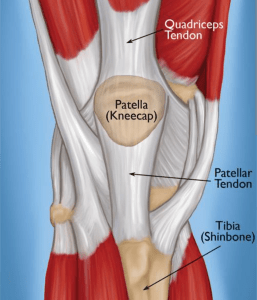
The suffix “itis” refers to inflammation. When you have tendonitis the tendon is inflamed. A more common term that I like to use for it is “irritated”. Your quad tendon crosses the front of your knee, and goes from the end of your quadriceps muscle group to your patella. It then turns into the patellar tendon and ends at the tibia (“shin bone”). Think of the quadriceps and patellar tendons as a road that begins as a paved road then changes to a dirt road. The tendon that attaches your quadriceps to your tibia starts as the quad tendon and ends as the patellar tendon. For simplicity in this post I’m going to refer to the painful region at the front of the knee as the quadriceps tendon.
When your knee is bending, the quad tendon is on stretch. If you have an irritated tendon, activities that put it on prolonged stretch, like sitting, may be aggravating. It is also usually aggravating for the tendon to shorten under a heavy load. The general term for pain in this region is patellofemoral pain. Depending on exactly where your pain on the front of your knee is, you may have patellar tendonitis. Treatment is the same either way. So, how do you get knee pain relief with quad tendonitis?
Step 1: Foam roll and stretch your quads
Often times I find that the quadriceps are very tight, or have a lot of trigger points. Try either laying on a foam roller for a few minutes twice a day to see if this helps. No foam roller? No need to purchase one. I’ve found that using a household rolling pin to roll out your muscles works just as well.

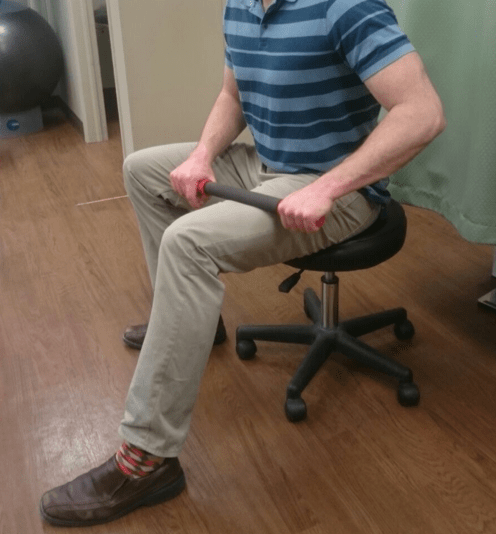
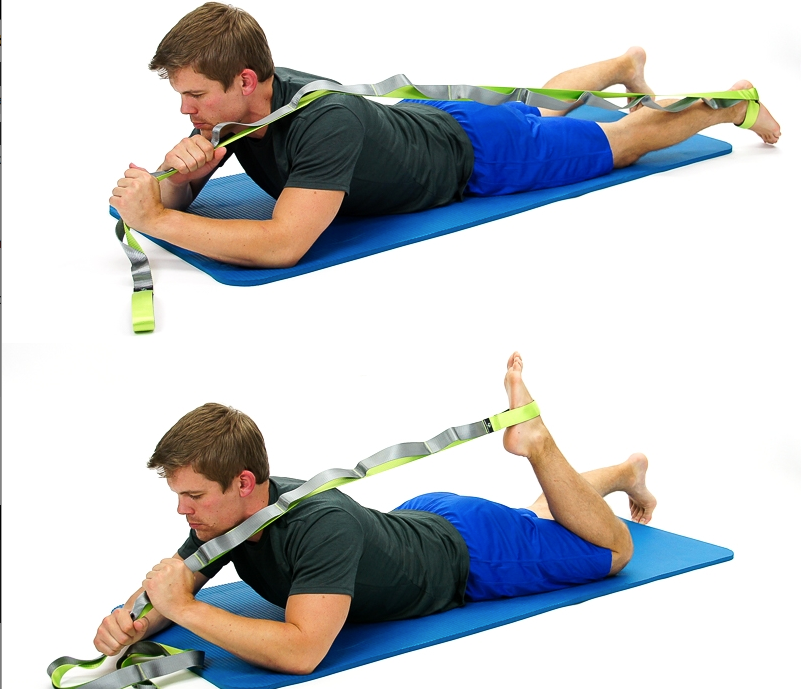
In addition to foam rolling, I also recommend stretching your quad. Please only go far enough to feel a quad stretch – don’t go so far that it increases the pain in the front of your knee. I suggest holding the stretch for 30-60 seconds, rest 10-15 seconds, and repeat 2-3 sets, one to two times daily. Here are some different ways you can stretch your quads (yes, there is more than one way!). The way that is “best” is the one that is most comfortable for you!

Step 2: Activate your glutes
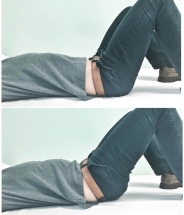
The quadriceps muscles are often overused and develop irritation at the tendon when the surrounding muscles are not doing their part. Our glutes (think: back of the hip) are supposed to stabilize us when we are walking, running, squatting, etc. The control from our hip determines the positioning of our knee. If our quads try to take over and do a job they are not meant to do, then after a while they become irritated. I suggest starting with a mini bridge, and then progressing to a marching bridge.
Something else to note – if you allow gravity to “plop” you down instead of using your muscles to lower yourself down, you are putting strain through your quad tendon. This also may cause irritation.
Make sure that you are feeling these exercises in your buttock muscles, NOT in your low back. See the pictures below.

Step 3: Perform eccentrics. Quadriceps Tendonitis Responds Very Nicely to Eccentrics
Perform ecc- what?
Eccentrics. This means that a muscle is contracting while it is lengthening. Picture the biceps – when the biceps shortens, it bends your elbow. When you allow your elbow to straighten, your biceps controls how quickly your elbow extends. If you were to pause the movement, your biceps would be the one holding your arm in place. This is an eccentric movement.
We want to perform eccentrics on the quad tendon because tendons do well with contracting during lengthening. There are several different ways we can do this for the quadriceps. For each exercise, you want to think of lowering down (motion where the knee bends) with your target leg, and coming back up (straightening the knee) with both legs. There are many ways to do this which include:
- Leg press pushing out with two legs, and lowering down with one
- Lowering to sit in a chair with one leg, then coming back up with two
- Performing long arc quads in a chair (kicking leg straight while sitting): Have your uninjured leg assist your injured leg up, then slowly lower the injured side down
Be sure to perform the eccentric (lowering) part of the movement SLOWLY. I suggest performing it over a 5 second count. It’s ok for a movement to cause mild discomfort at the quad tendon but we do not want to push into pain. Pushing into increasing knee pain can just continue to irritate your tendon.
As always, I suggest an evaluation in person with a physical therapist as it is easy to misdiagnose yourself. Additionally, everyone has slightly different needs in therapy. Two people with the same diagnosis will respond differently to physical therapy, so it is important to take an individualized approach.
Leave a Reply