
Many people come to me saying they’d like to build strength in a specific body region, but are struggling to do so. Want to know my favorite technique to use in the clinic with patients who need to build strength? Eccentric strength training!
There are two parts of an exercise: the concentric part and the eccentric part.
When muscles contract, they shorten. They work like levers that shorten over a joint in order to move it. When the muscle is contracting while shortening (think: during a biceps curl, the muscle gets shorter as you lift the weight), this is the concentric part of the movement. When the muscle is contracting while it’s lengthening (think: during the biceps curl this is the part of the movement where the weight is being lowered), this is the eccentric part of the movement.
You may think “Doesn’t the biceps bend the elbow, and the triceps straightens it?” You are correct – BUT there is something to keep in mind. When you’re doing a biceps curl, as you lower the weight you aren’t straightening the elbow. Think of it as allowing it to “unbend.” Take a look at these pictures. In the top photo, the man is performing a biceps curl. In the second photo, the man is performing triceps extension. Both of these are the same movement from the elbow. The difference is where the resistance is coming from – this determines which muscles are being worked.
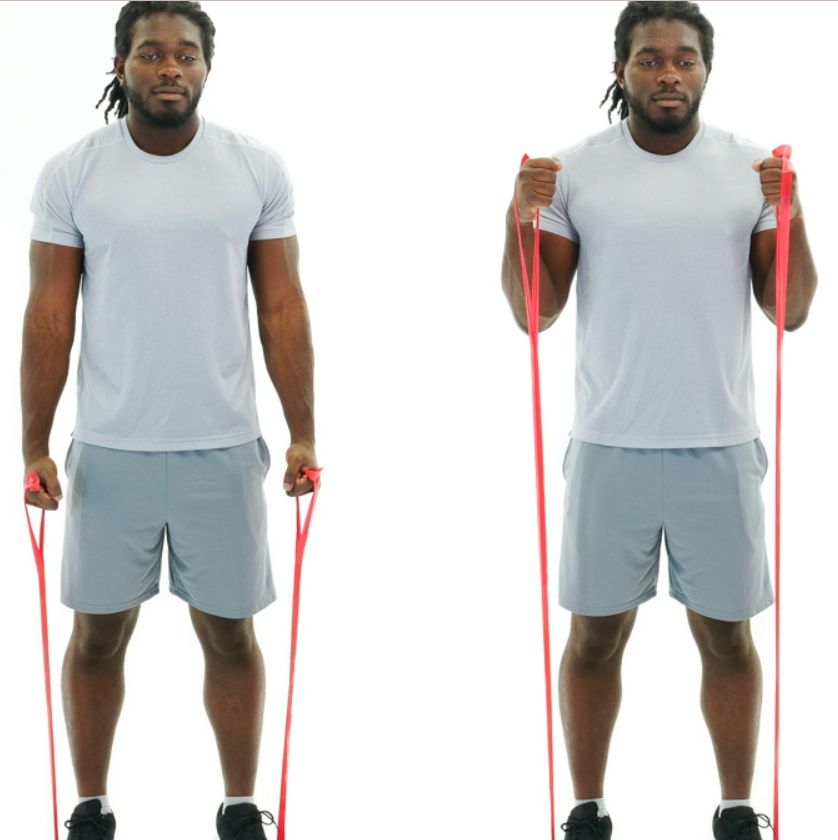
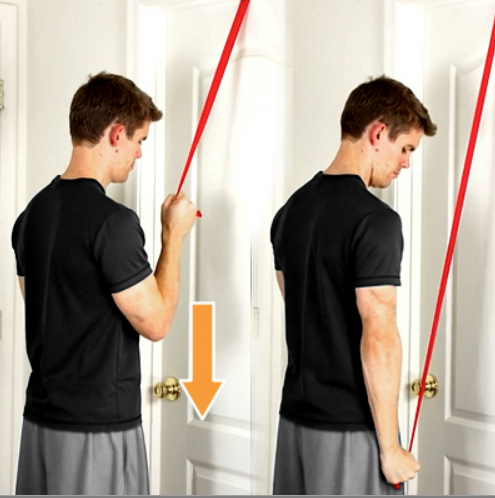
Go ahead and do a biceps curl right now. Lower your hand halfway down and pause. Then lower it a little more. Pause again before you get to the bottom. Your biceps is doing the work and is keeping your arm from straightening. The muscle that is working depends on the positioning of your body.
Have you ever noticed that it’s easier to lower something down than it is to pick it up?
Have you ever noticed that it’s easier to lower something down than it is to pick it up? Think of lowering a heavy box to the ground from a table. You may have been able to lower it to the floor, but you might not be able to put it back onto the table. This is because during concentric work, we only have muscle doing the lifting. During eccentric training we have our muscles, ligaments, and tendons working together to “lower” something.
Since we are able to “lower” more weight than we can lift, a muscle is able to be put under a higher load with eccentric strength training. This is an amazing way to build strength quickly!
How exactly do you perform eccentric strength training?
There are MANY ways you can perform eccentric strength training on your own! I like to say “up with two, down with one.” Let’s say you are trying to perform a one-legged squat to a chair (going from sitting to standing). Lower down to the chair on leg leg, then come up with two legs. You are doing the concentric work (“going up”) with both legs, and eccentric work (“lowering down”) with two legs.
For a movement with your arms you could raise up with two arms and lower down with one. For something like pull-ups jump into the pull-up using your legs, then use your arms and back to slowly lower yourself down.
A key part of strength training correctly is performing the eccentric movement SLOWLY.
People will sometimes drop a weight during their reps instead of slowly lowering it. This can cause strain on our muscles and tendons instead of benefitting them. Fast movements are certainly beneficial, but if strength itself is your goal I recommend against this. If anything, I would move slowly during the eccentric portion and quickly during the concentric portion. This way you reduce your risk of injury and maximize your payoff.
Now onto a key question: How many sets and reps should you do?
I would pick one to two exercises to add to your weekly routine, and perform them specifically for eccentric strength training. Try doing this one to two times a week on non-consecutive days. I suggest picking a weight that is heavy enough that you cannot do more than 8 repetitions with good form. Perform for 3-4 sets, resting for 1-2 minutes in between. In a couple of weeks you should be able to add more weight.
Looking for more strengthening ideas?
The exercise database has you covered! Currently this database has dozens of strengthening exercises for various body regions. I will be adding to it weekly! To access it, subscribe to my **free** newsletter using the box at the stop of this page. You will be sent a password so you can access the database.
Leave a Reply