
Here’s the scenario: You had surgery (or possibly just an injury without surgery) on your lower extremity and now you’re on crutches. You’re starting to feel stir crazy and you’re wondering, “When can I get off my crutches?!” This post will explain what PT’s look at when deciding if it’s appropriate to wean from crutches or not.
First, it depends on what type of surgery you had.
There are some surgeries that involve being non-weightbearing (no weight through your surgical leg at all) for several weeks. There are other surgeries that are “weightbearing as tolerated” after surgery. This is exactly what it sounds like: you’re allowed to put some weight through your leg while on crutches. This doesn’t mean full-on walking without support – just putting as much weight as your leg can handle, slowly increasing over time.
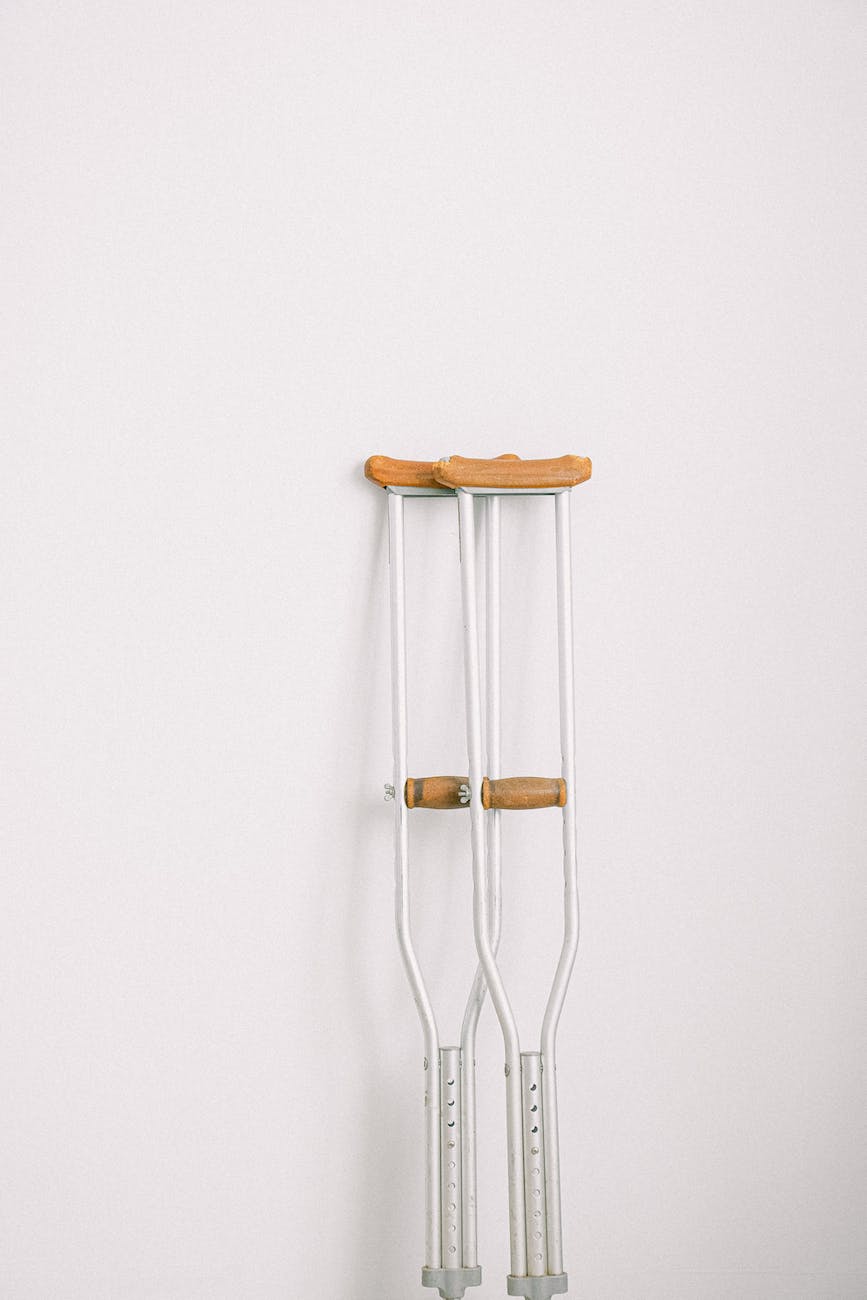
Time on crutches for ACL reconstruction depends on how much damage there was, and what type of graft was used.
The amount of weight you’re allowed to put through your leg depends on what tissues were repaired, and how this was done. For example: an ACL repair is somewhat fragile. It takes 9 months for the new graft to really become the new ligament (a process called ligamentization). An ACL plus meniscus repair is even more fragile. An ACL plus meniscal root (what anchors the meniscus) repair is VERY fragile. Other surgeries that may requires a patient to be non weightbearing include labral repairs (hip), and certain ankle surgeries. You need to allow time to pass so that your body can heal.
Some surgeons allow their ACL patients to weight bear as tolerated immediately after surgery. This is dictated by type of graft. Most patients with a cadaver graft start walking much sooner. This is because the other graft options are autografts. This means that they come from your body. The part of your body this was taken from is now injured as well, and needs some time to heal.

Other procedures such as meniscectomy (meniscus removal when it can’t be repaired), hip and knee replacements allow patients to walk in their crutches/walker immediately after surgery. With a joint replacement the healing tissues are mainly where the incision was. The new hardware is solid in the joint. With a meniscectomy there is no repair to be mindful of. The damaged tissue has been removed and the patient can gradually return to their previous level of activity (with physical therapy).
Time on crutches following foot or ankle surgery varies greatly.
The amount of weight you are allowed to bear following a foot or ankle surgery varies greatly depending on the extent of the damage. Generally speaking if bone is involved, you will be able to put weight through your foot relatively soon, if not immediately (usually in a boot). If there was extensive ligament reconstruction, you might be non-weightbearing for up to 12 weeks.
Regardless of timeline, there are very specific things I look for before clearing my patients to walk without crutches.
There is a well-studied movement pattern called the gait cycle. This refers to the biomechanics throughout our body when someone is walking. When you are walking, your knee bends and straightens throughout the gait cycle. The main things I look for in my patients are:
- Their knee must be straight when their foot is under their body. This is the point where one foot is lifting off the ground – your other leg will be directly under you. If the knee is bent this means there may be: quadriceps weakness, hamstring guarding, or joint stiffness.
- No limping. If you can’t walk without a limp in your crutches, then you can’t walk without a limp without them. It’s more difficult to unlearn a limp than it is to simply wait another week or two. Additionally, walking with a limp can bring on other issues like back pain.
- Your knee needs to bend as it swings through the air from behind your body to the front of your body. If you’re swinging your leg out to the side or hiking up your hip on that side to get your knee through, you’re not ready.
- Your foot needs to end up behind you before it lifts up. If you lift up your foot too early, your ankle may be too stiff or your calf muscles may be weak/injured.

What happens if you get off crutches sooner than you’re told to?
There are a few adverse events that I have seen happen when people take themselves off their crutches before I gave the ok (9 times out of 10 these were knee surgery patients). These patients ended up walking on a slightly bent knee because their quads were not strong enough to support them. Since they were walking on a stiff, guarded knee this resulted in increased swelling and pain. Despite being “off their crutches” sooner, most of these patients progressed more slowly than other patients with the same injury. This is typically a phenomenon I see with knee patients as opposed to hip or foot/ankle patients.
If your surgeon and physical therapist are telling you two different things, listen to your PT.
I have had several patients who need to stay on crutches slightly longer than planned because of one reason or another. Some people build up excessive scar tissue resulting in a harder time getting their range of motion back. Other people are delayed in getting a PT appointment and become very weak in the meantime. It takes them a little longer to regain the strength necessary to walk without crutches.

I have had several surgeons who tell their patients during follow-up visits that they can get off crutches before they are ready. This is because some surgeons look only at the timeline: “At 4 weeks most people are off crutches. Therefore this patient is ready to be off crutches.” They don’t take into account the subtle issues that the physical therapist sees. This only happens to my patients when they see a surgeon who doesn’t know me. If I have a patient who is behind schedule, I try to give their surgeon a call to fill them in before our patient goes in for their follow-up appointment. This usually clarifies the reasoning behind the crutches to the surgeon.
In summary, it depends on the tissues we are protecting and on your ability to walk smoothly without crutches.
I want to clarify that when I say “protect tissues” I am NOT referring to bedrest or just sitting around. In physical therapy we know what movements strain what tissues. We can continue to strengthen the lower extremity in a safe way. This minimizes atrophy and makes things move much faster and more smoothly once you are finally off of your crutches.
An example I have is of a syndesmosis reconstruction: a severe “roll” of the ankle which resulted in rupturing several critical ligaments. Surgeries like this require patients to be non weightbearing for 12 WEEKS. What do I do with a patient like this? Lots of things:
- manual therapy (“massage”) to reduce tightness in the foot and surrounding muscles
- gentle ankle work like doing tracing the ABC’s in the air
- leg raises, long arc quads, straight leg raises, and hamstring curls to keep the rest of the leg as strong as we can
Twelve weeks is an incredibly long time to be on crutches. Most patients will not have to be on crutches for so long. In case you were wondering, the patient in this scenario did VERY well. As soon as we were cleared to get off crutches their legs had remained strong and mobile, so walking was pretty easy!
Everyone’s situation is slightly different. I always recommend having a discussion with your PT about why you are still on crutches if you’re concerned.
Leave a Reply