
I noticed that many of my patients with elbow pain tend to self diagnose themselves. They come in asking, “Is this tennis elbow?” or “Is this golfer’s elbow?” at least half the time. Let’s discuss what each of these conditions mean, and what other conditions it could be. Please keep in mind that this is by no means an exhaustive list, and you should see your healthcare provider for a work-up and clear diagnosis.
Tennis elbow and golfer’s elbow involve irritation of the wrist flexors and extensors. Here is what wrist flexion versus extension looks like.
Huh? The wrist? Isn’t this post about the elbow? Trust me, it will all make sense in a minute.
Wrist extension is if you are standing with your arms parallel to the floor and palms facing the floor, pulling the back of your hand towards your face. Wrist flexion would be moving your hand so that it’s parallel to your body, and fingers perpendicular to the floor.
Tennis elbow occurs with irritation of the wrist extensor group. Pain commonly occurs with gripping activities.
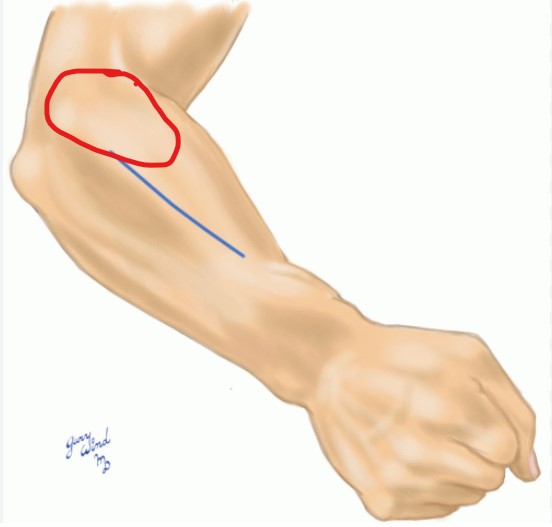
Lateral epicondylalgia, commonly referred to as “tennis elbow“. This is pain resulting from an irritated muscle group that does wrist extension. The muscle group that extends our wrist attaches to the lateral aspect (outside) of the elbow – this is the reason why wrist positioning comes into play. Individuals with this condition tend to have more pain with gripping activities such as carrying groceries or lifting a frying pan. You may have “tennis elbow” if:
- You have pain with resisted wrist extension
- You have pain with passive wrist flexion
- You have tenderness to the touch of the muscle bulk on the outside of your elbow. “Outside” refers to if your arms are at your sides with palms forwards, the part of the elbow farthest from your midline. If you extend your wrist, you can feel this muscle group pop into your fingers if you just rest your opposite hand in this area.
This list sounds very specific but I promise, it is still vague. Get checked out by a physical or occupational therapist if you’re unsure.
Golfer’s elbow involves irritation of the wrist flexor group.
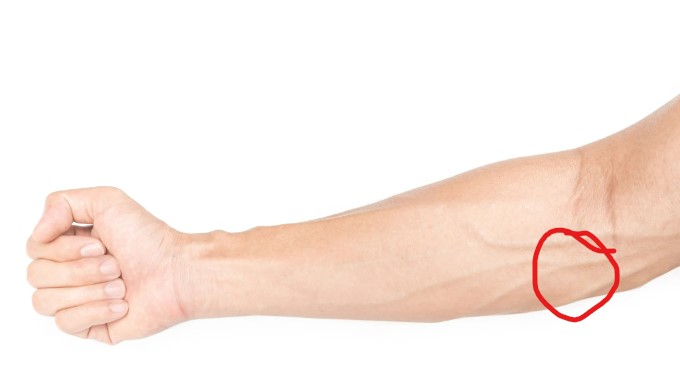
Medial epicondylalgia, commonly referred to as “golfer’s elbow” is pain on the inside of the elbow. So if you are standing with your arms at your sides and palms forwards, it is the side of your elbow closest to your body. Again, wrist position will matter here because the muscles involved are those that flex the wrist. This muscle groups attaches to the medial aspect (inside) of the elbow. You may have golfer’s elbow if:
- You have pain with resisted wrist flexion
- You have pain with stretching into wrist extension
- You have tenderness with touching the wrist flexor mass. Place your hand on the medial (inside) area of the elbow, on the side of the elbow crease that is closer to your hand (but stay close to the crease). Flex your wrist – you should feel this muscle group contracting under your fingers.
There are many potential causes of elbow pain besides golfer’s and tennis elbow.
There are actually MANY other things that can be going on. I have found that in several of my elbow patients, more than one thing is going on. As I work with a patient and address one condition, another underlying one reveals itself for us to address. Other potential elbow injuries include:
- Triceps tendonitis
- Tear of the ulnar collateral ligament (ligament tear on the medial side, which is the “inside”)
- Posterolateral rotary instability (ligament tear on the lateral side, which is the “outside”)
- Elbow dislocation or fracture
- Biceps tendon rupture
- Triceps tendon rupture
- Nerve entrapment
- Condition involving the neck or shoulder, which refers pain to the elbow
There are many more injuries including fractures and tears of other ligaments I did not name. Also, as I mentioned earlier, there can be several things going on at once. I once had a patient who had elbow pain due to tension in her nerve, both medial and lateral epicondylalgia, and carpal tunnel syndrome. We slowly addressed each issue until she was pain-free. Not everyone has as complicated of a presentation as this patient did, but it does happen. This is why I recommend against self diagnosis if you’re having lingering issues. If you’ve been having pain for a long time that isn’t improving, or if you fell and landed on your arm or hand and are having pain, I recommend talking to your healthcare provider.
Leave a Reply