
Headaches are very complicated with many potential causes. One cause that we are able to address in physical therapy is a headache that comes from the neck. Headaches that are caused by cervical (neck) issues are called cervicogenic headaches. This post will specifically discuss a ram’s horn headache, which is referred from the upper trapezius.
Referred pain is pain in one region that is caused by dysfunction in another region.
Individuals with ram’s horn headaches can often reproduce their pain by pressing trigger points in their upper traps. A trigger point is a taut band of muscle. More commonly, this is known as a “knot” in the muscle. Trigger points can appear in any muscle in our body. Some are only tender with pressure on the trigger point themselves. Others refer pain to another region when pressed.
In the case of upper trap dysfunction, pressing a point on the upper trap causes a ram’s horn headache pattern.
Sometimes people have a headache without needing to press on the upper trap. However, pressing on the upper traps increases the headache’s intensity. The headache is located anywhere from the back of the neck to the eye, as shown in the picture below.

The first treatment option for ram’s horn headaches is trigger point release.
Trigger point release is exactly how it sounds: working out the “knots”. You can do this yourself by pinching a knot between your thumb and index finger, and tilting your head towards and away from the knot. You can also have someone else apply deep pressure to the knot to work it out.
Another way to release trigger points is through dry needling. A variety of medical providers are able to perform functional dry needling, including physical therapists. There is a special certification course a provider needs to take before they are able to safely dry needle patients.
After releasing the trigger point, keep your upper traps loose by working on your scapular positioning.
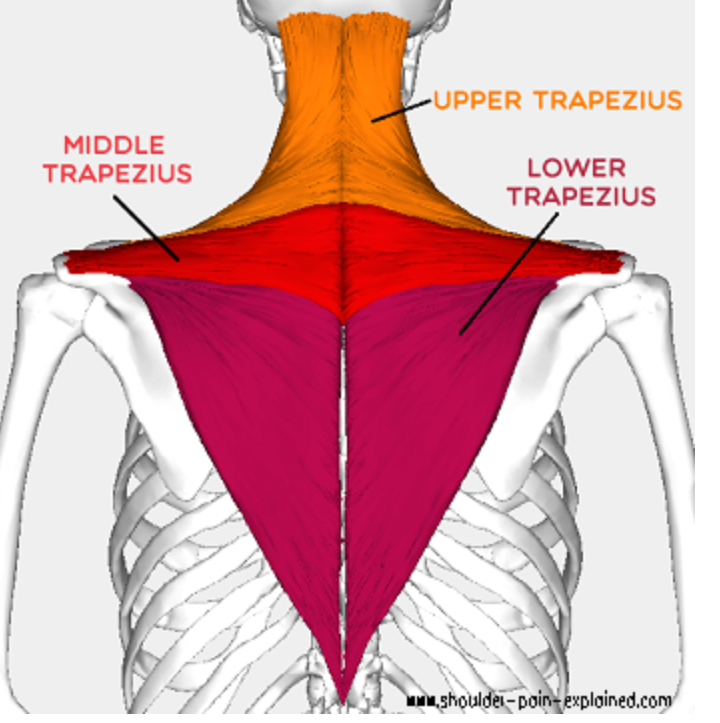
The scapula is the shoulder blade. The scapulae move upwards when we shrug our shoulders – an action performed by the upper trap. To keep your upper traps loose, you want to strengthen the lower trap. The lower traps bring your shoulder blades down and together. They keep your shoulders from shrugging when you lift your arms overhead. You can strengthen your lower trap by performing:
- Standing Y’s
- scapular squeezes
- Serratus wall slides
I’d like to add that it’s not inherently bad to shrug your shoulders. It’s just not preferred to do it uncontrollably.
Lastly, you may need to work on some motor control for your neck.
Motor control is control of our movements. Many people compensate for a lack of precise cervical control by using their upper traps. This post contains some exercises you can try for improved cervical motor control.
This post is not an all encompassing post on headaches.
Again, headaches can be extremely complex. A variety of factors can cause headaches, including but not limited to: vascular compromise, concussion, brain injury, vestibular deficits, and underlying illness. If you suffer from headaches and they don’t respond to the interventions in this post, please see your healthcare provider for further workup.
Leave a Reply