
Patients come to me for a variety of reported symptoms in their back and hips, self diagnosing themselves as having “piriformis syndrome”. Let’s talk about why this is impossible to self diagnose.
Let’s start by defining the piriformis
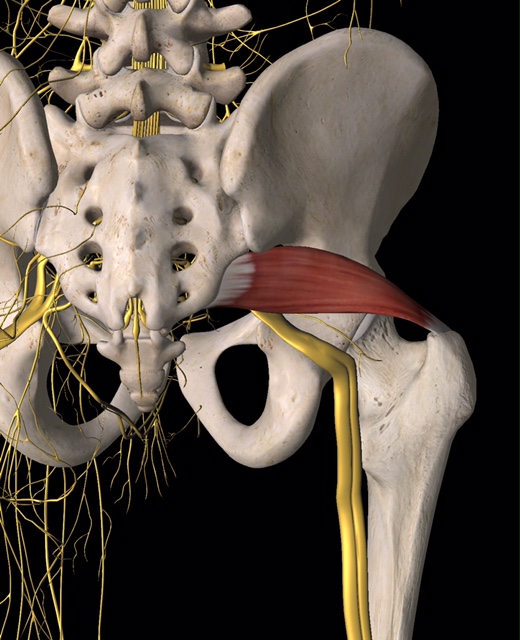
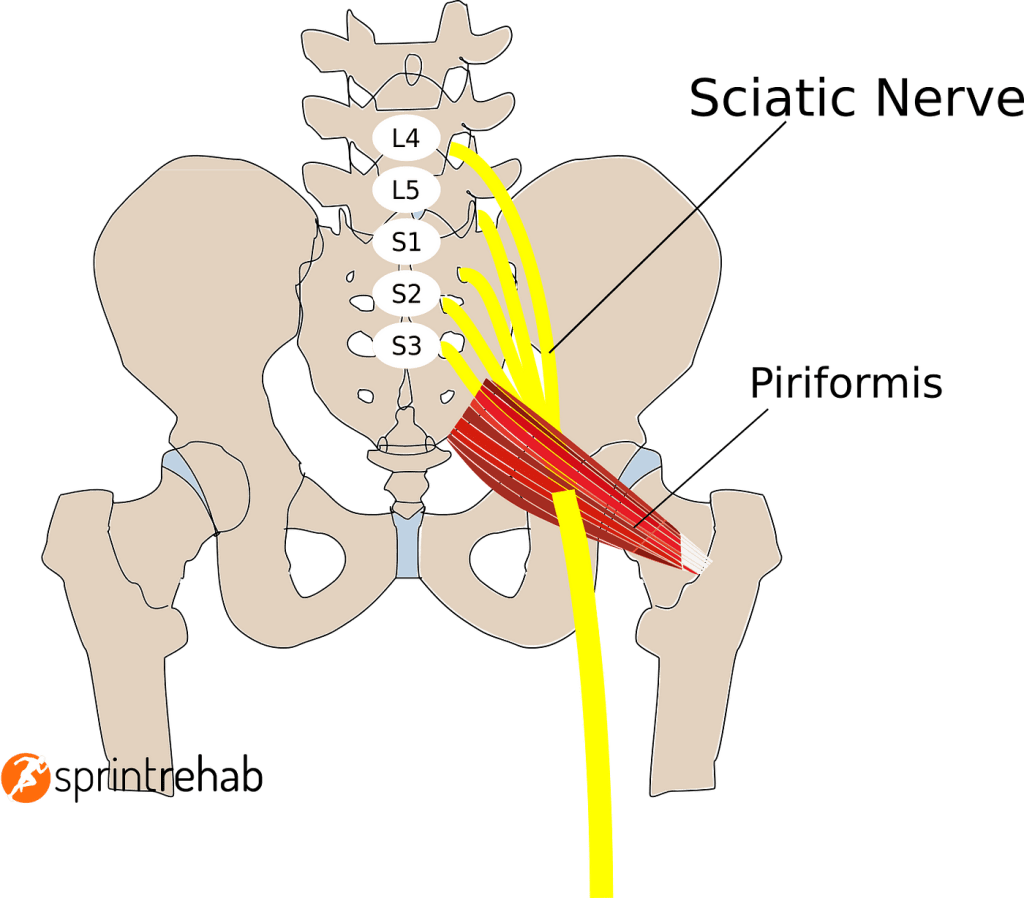
The piriformis is a muscle that attaches from our sacrum to our greater trochanter (the part of the femur we think of as the outside of the hip). When this muscle contracts, it externally rotates the hip. This means that if you’re standing facing forward, it will rotate your knee to point outwards, away from midline.

This muscle also sits over the sciatic nerve. This means that if you were to cut into the body and peel away each layer you found, you would peel away the piriformis and find part of the sciatic nerve sitting underneath it.
So, what is piriformis syndrome?
Piriformis syndrome is a rare condition where people are born with their sciatic nerve going through their piriformis. The nerve literally goes through a small opening it makes in the muscle. People with this condition may have tingling or pain down the back of their leg from nerve compression if this muscle gets tight.
Here’s the thing – not everyone who is born with this condition has symptoms. Some people have this anatomy but never have issues. In order to diagnose piriformis syndrome, you would need at MRI. An x-ray will NOT show this condition because x-rays visualize bones, not soft tissue. However, this is completely unnecessary. I do not need to know if someone actually has piriformis syndrome in order to get them better. More on this in a bit.
An MRI does not show if a muscle is tight, or if you are moving in a way that irritates your hip. I don’t recommend any imaging for piriformis pain except to rule out “sinister” issues. I typically only recommend this if :
- I can’t reproduce someone’s pain in the clinic
- The pain pattern being described doesn’t make sense
- A patient is not responding to PT the way I expect them to
Pain down the back of the leg has a variety of potential causes
This topic alone could be a very long blog post. Symptoms down the back of the leg MAY be contributed to by a tight piriformis, but it doesn’t mean it is “piriformis syndrome”. Remember, piriformis syndrome is the condition where the nerve pierces through the muscle.
Symptoms down the back of the leg may be caused by:
- An issue in the spine
- Hamstring injury or irritation
- Sciatic nerve irritation from a variety of factors
This is by no means an exhaustive list, but for simplicity I’m keeping it brief.
The piriformis can be irritated without having piriformis syndrome
The piriformis is a muscle that likes to tighten up on people. This can cause tightness and pain in the back and side of the hip. Again, this will need to be its own blog post. Treatment for piriformis pain varies widely and is based on the individual. Though stretching may bring relief, I don’t feel it is usually enough to resolve symptoms long-term.
So you don’t need to know if I have piriformis syndrome in order to treat my pain?
Nope! Remember, not everyone with piriformis syndrome has symptoms. In the clinic I take a look at:
- Your strength, which I test with manual resistance
- Your range of motion
- Your body mechanics – how do you like to move?
- Which muscles are tight, tender, agitated
If you do have piriformis syndrome, it doesn’t change the treatment. There is nothing that can be done to move your sciatic nerve out of your muscle! What we do in general is calm down the area, and dose exercises and stretches in a way that makes sense for your body.
Leave a Reply